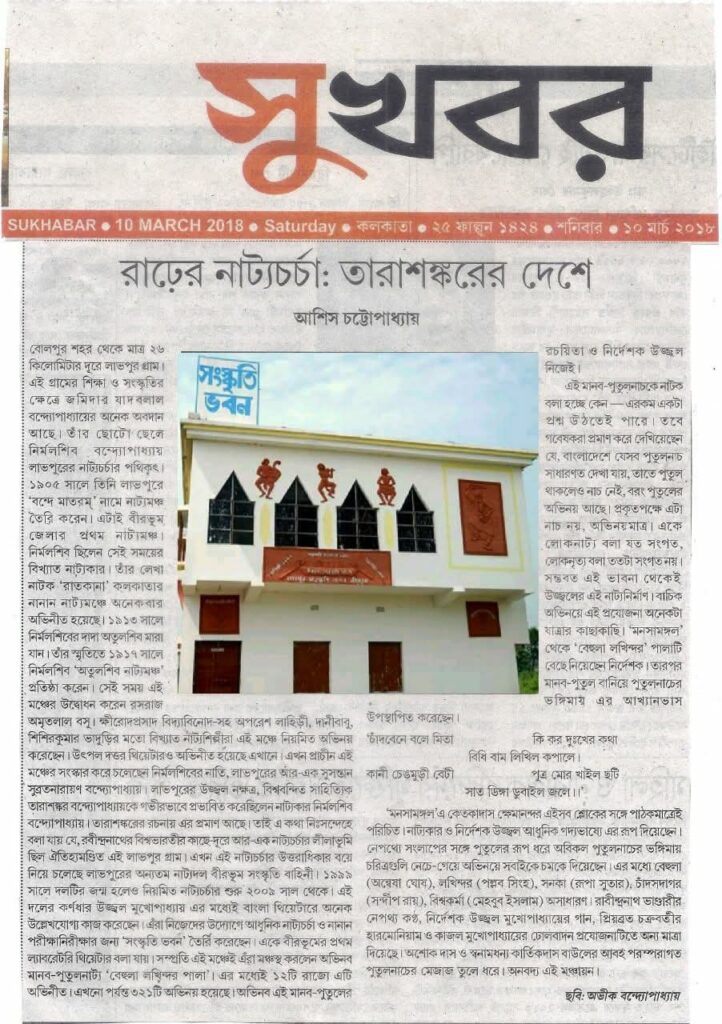
This feature article focuses on Labhpur, the birthplace and literary landscape of renowned Bengali novelist Tarashankar Bandyopadhyay, and highlights the remarkable theatre movement led by Birbhum Sanskriti Bahini under the leadership of Ujjal Mukhopadhyay.
The writer begins by noting that although Labhpur is a small rural town located about 26 kilometers from Bolpur, it possesses a rich cultural and artistic heritage. The region has long been associated with literature, folk traditions, and theatre.
The Birth of a Theatre Movement
The article explains that in 1998, Ujjal Mukhopadhyay founded a theatre group called “Setu”, which became one of Birbhum’s pioneering theatre organizations. Through this initiative, many local youths became involved in theatre and cultural activities.
Over time, Ujjal Mukhopadhyay wrote, directed, and produced numerous plays. His work received recognition in various theatre festivals and cultural gatherings.
Establishment of Sanskriti Bhavan
One of the major achievements discussed in the article is the establishment of “Sanskriti Bhavan”, a dedicated cultural centre created by Birbhum Sanskriti Bahini.
The article describes the centre as:
- A venue for theatre rehearsals
- A training institute for young artists
- A cultural learning space
- A centre for preserving folk traditions
- A meeting place for artists and cultural workers
The building itself is portrayed as a symbol of the organization’s commitment to cultural development.
Theatre Training and Cultural Education
The report notes that Birbhum Sanskriti Bahini regularly conducts:
- Theatre workshops
- Acting training programs
- Folk culture education
- Music and dance instruction
- Children’s cultural development programs
Many students have benefited from these activities, helping create a new generation of theatre practitioners and cultural workers.
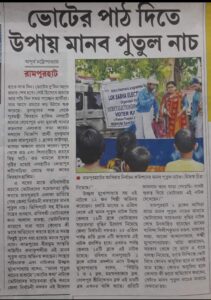
Human Puppet Theatre
The article highlights one of Ujjal Mukhopadhyay’s most celebrated innovations — the Human Puppet Theatre (Manab Putul Natya).
Inspired by Bengali folk traditions, these productions use live actors performing with puppet-like movements and expressions. The form has become a distinctive contribution to contemporary Bengali theatre.
Particular mention is made of productions such as:
- Behula Lakhindar Pala
- Other folk-based theatrical adaptations
which gained widespread appreciation from audiences and critics.
Connection with Tarashankar Bandyopadhyay
The article emphasizes that the cultural work of Birbhum Sanskriti Bahini is deeply connected with the literary and folk traditions associated with Tarashankar Bandyopadhyay.
Several productions have been inspired by:
- Rural Bengal
- Folk beliefs
- Local history
- Human relationships
- Village life
all themes frequently found in Tarashankar’s writings.
Artistic Recognition
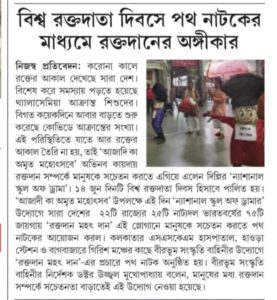
The writer praises Ujjal Mukhopadhyay’s dedication and describes him as a cultural organizer, playwright, director, and educator whose efforts have significantly enriched the cultural landscape of Birbhum.
The article notes that despite operating from a rural area, the organization has achieved recognition across West Bengal and beyond.
Conclusion
The feature concludes that Labhpur’s theatre movement demonstrates how cultural excellence can emerge from rural Bengal. Through continuous work in theatre, education, folk culture, and social awareness, Birbhum Sanskriti Bahini has transformed itself into one of the region’s most important cultural institutions.
Photo Caption
Sanskriti Bhavan at Labhpur — the cultural centre established by Birbhum Sanskriti Bahini.